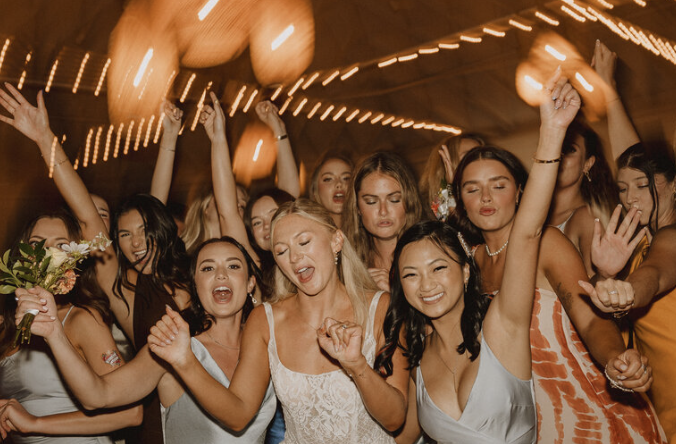

Most couples think party photos are wild, unpredictable, and nearly impossible to make look stylish—like they’re destined to become blurry proof that the dance floor existed rather than something they’d proudly hang in their home.
But the truth is this:
The dance floor is where your real wedding personality shows up.
Not in the poses.
Not in the ceremony.
Not in the perfectly styled tablescape.
It shows up:
- when your friends scream the lyrics to your favorite song
- when your dad surprises everyone with dance skills he hasn’t used since 1998
- when your maid of honor cries from laughing too hard
- when you look at each other across the room and think, “This is the best night of our lives.”
These are not “throwaway moments.”
They are the emotional heartbeat of your wedding—and they deserve to be photographed with intention, not luck.
This guide breaks down how I create party photos that feel alive, elevated, and editorial—images you’ll actually want to print, frame, and relive for years.
01. Chaos Doesn’t Photograph Well—Energy Does
There’s a difference between chaos and energy.
Chaos is uncontrolled motion.
Hands in random directions, faces blurred beyond recognition, limbs cut off, lighting that turns skin orange or blue.
Energy is intentional motion.
Movement that tells a story.
Facial expressions you can feel.
A rhythm in the frame.
A sense of shared experience.
Most photographers treat the dance floor like survival mode—just spray and pray.
But that’s a recipe for chaotic images, not meaningful ones.
Here’s the truth:
The best party photos aren’t about freezing movement.
They’re about translating energy.
And that takes skill—technical, emotional, and environmental.
02. Setting the Stage: Why the Dance Floor Environment Matters More Than You Think
Even the best photographer can’t create magic on a badly designed dance floor. The environment influences lighting, composition, and the type of movement you’ll get.
Here’s what makes a dance floor visually successful:
1. Light That Isn’t Working Against You
Dark corners?
Terrible.
They swallow faces and kill atmosphere.
Harsh uplighting?
Even worse.
Hello, neon chin shadows.
What works:
- Warm overhead lighting
- Spotlighting that creates contour
- Candlelight + ambient glow for depth
- DJ lighting that enhances, not overpowers
Good light = good energy.
2. Space to Move
Cramped dance floors lead to:
- stiff movement
- blocked faces
- tangled arms
- no negative space
A spacious dance floor leads to:
- clean compositions
- bigger reactions
- expressive shots
- dance moves worth documenting
Couples underestimate this constantly.
The more room people have, the more confident they dance—and confidence photographs beautifully.
3. A Crowd That’s Actually Invested
A half-empty dance floor won’t suddenly come alive at 10pm.
Guests need:
- good music
- good flow
- good transitions
- a comfortable temperature
- drinks they can actually access
The photographer captures the energy—but the energy has to exist.
03. Flash: The Tool That Transforms Party Photos From Muddy to Magical
Flash used poorly is harsh and unflattering.
Flash used intentionally is art.
Think:
- crisp highlights
- vibrant eyes
- motion that feels alive
- atmosphere that feels electric
The West James flash style is clean, modern, and editorial—not “club kid from 2005.”
Why Flash Matters So Much at Receptions
Most receptions are dim. Your venue’s lighting is meant for ambiance—not photography. Without flash:
- skin tones get muddy
- shadows swallow faces
- motion becomes unintelligible
- images flatten completely
Flash reveals details your eyes can’t see in the moment.
The West James Flash Philosophy
Flash is not a blunt instrument. It’s sculpting.
I use flash to:
- highlight the subject without blowing out the background
- add depth, not flatten the image
- capture motion, not freeze it into stiffness
- translate an atmosphere, not override it
This is the difference between “just a party picture” and an iconic reception shot.
04. Motion: The Art of Controlled Blur
Most people fear motion blur.
But motion blur is where the magic happens.
Blur can:
- show movement
- communicate rhythm
- reveal atmosphere
- heighten emotion
The key is intentional blur—where the subject remains the anchor while the world dances around them.
The Three Types of Motion That Photograph Best
1. Rotational Movement
Think twirls, spins, dips.
2. Forward Movement
Walking toward the camera?
Electrifying.
3. Chaotic-but-controlled Group Movement
Friends jumping, dancing, arms raised, bodies in harmony.
This is where the “we were really there” feeling lives.
05. Directing Without Interrupting:
The Photographer’s Dance-Floor Role**
A lot of photographers freeze on the dance floor.
They’re afraid to get in the mix, to direct, to guide.
So they hang back.
And they miss everything.
My job on the dance floor is part observer, part director.
When to Lead
If the energy dips, I guide:
- “Stay where you are—do that again!”
- “Everyone get around them!”
- “Lift her on three!”
- “Grab hands and pull in close!”
Little prompts create big moments.
When to Disappear
When the energy is already flowing, I disappear into the chaos:
- shooting from inside the circle
- moving with the rhythm
- letting the moment shape itself
It’s a dance—literally.
The best photographer becomes invisible when needed and present when invited.
06. Timing Is Everything:
Why the Best Party Photos Don’t Happen When You Think They Do**
Most couples assume the photographer should leave early or stop after the first dance floor surge.
Nope.
The best dance-floor photos happen at the 30–40 minute mark after the floor opens.
Here’s the arc:
0–10 Minutes: Warm-Up
People are self-conscious.
Couples sway.
Parents take polite steps.
Good photos? Sure.
Great ones? Not yet.
10–20 Minutes: Comfort Zone
People loosen up.
Shoes come off.
Laughs get louder.
Still not peak energy—but close.
20–40 Minutes: The Sweet Spot (Peak Energy)
This is where the magic hits.
You get:
- big reactions
- bold movement
- uninhibited expression
- the most iconic photos
This is the point where couples become themselves again—fully, joyfully, unfiltered.
Why You Frame These Photos
Because these aren’t photos of your wedding.
They’re photos of your life—your friendships, your joy, your personality, your connection.
The dance floor is where relationships reveal themselves.
07. The Emotional Language of a Dance Floor
Some people think the dance floor is superficial joy.
It’s not.
It’s emotional storytelling.
You see:
- community
- celebration
- connection
- inside jokes
- history
- belonging
That’s why great dance-floor photos hit harder than staged portraits—they’re full of personality.
This is not about documenting dancing.
It’s about documenting your people in their most alive state.
08. How to Get Frame-Worthy Party Photos:
Your Guide to Setting the Scene**
Great party photos aren’t luck.
They’re built.
Here’s how to set the stage for success:
1. Curate the Guest Experience
Your guests will give back the energy you put into the day.
Want an alive dance floor?
- Keep speeches tight
- Open the floor early
- Choose music that actually moves people
- Position the bar near the dance area
- Avoid long formalities that stall momentum
2. Create an Environment Guests Want to Be In
Temperature, crowding, lighting, and seating all matter.
If guests are uncomfortable, they won’t dance.
3. Choose Music That Supports the Emotional Arc
Start with familiar sing-alongs, then move into dance-heavy beats.
Mix nostalgia with modern energy.
Let the DJ build waves of movement.
4. Let the Photographer Stay Long Enough
If you want the real energy captured—not the polite warm-up—coverage needs to extend past the initial burst.
Your future self will thank you.
09. What Makes West James Dance Floor Photos Different (This Is the Secret Sauce)
There are three elements that separate iconic party photos from forgettable ones:
A. Proximity
I don’t shoot from the sidelines.
I shoot in the moment.
This means:
- strangers grabbing me into the circle
- lens inches from laughter
- movement all around me
- dancing while photographing
Proximity creates intimacy.
B. Timing
I don’t shoot the moment you think will be good.
I shoot the microsecond before it.
Experience gives you instinct.
Instinct gives you timing.
C. Emotional Attunement
This part is invisible—but vital.
I read:
- the vibe
- the energy
- the group dynamics
- who’s shy
- who’s bold
- who’s about to explode into laughter
This is how you capture personality—not just action.
10. Editing: Where Energy Becomes Art
Editing reception photos is an art form.
Too much contrast? Chaos.
Too warm? Muddy.
Too cool? Lifeless.
Too sharp? Harsh.
The West James edit:
- preserves skin tones
- maintains depth
- keeps the atmosphere intact
- enhances the pulse without overpowering it
The result:
Party photos that feel alive, not overwhelming.
11. Why Couples End Up Framing Their Reception Photos (Even When They Didn’t Expect To)
People expect to frame:
- portraits
- ceremony photos
- golden hour shots
But the frames that end up on walls years later?
The dance-floor moments.
Why?
Because:
- they capture your real personality
- they show relationships in motion
- they age well
- they tell the truest story
These photos become heirlooms because they show who you were, not just how you looked.
12. Final Thoughts: The Party Is More Than a Moment—It’s a Chapter
A wedding isn’t defined by calm or by chaos.
It’s defined by contrast.
The ceremony gives you stillness.
The portraits give you romance.
But the dance floor gives you life.
Your people.
Your joy.
Your energy.
Your relationship in motion.
And that deserves to be photographed with the same intentionality as every other part of your day.
Not chaotic.
Not messy.
Not disposable.
Artful. Honest. Alive. Frame-worthy.
The West James way.


Comments +